Showing posts with label The Moonstone. Show all posts

Wednesday, February 2, 2011

Victorian Men

I realized I have discussed some of the gender issues for Victorian women in The Moonstone, but there are also issues for the men.

The two young cousins Franklin Blake and Godfrey Ablewhite are typical of upper middle class men. Franklin we are told has spent through the money he inherited from his mother and has debts but he also has expectations from his father. He has been educated abroad because of his father's eccentricity but it is also clear that his education is the more bohemian of the two cosuins. He describes living with an artist in Italy and learning the decorative painting and creating the medium for paint while being there. His opinions at dinner are also more Bohemian. Even his facial hair would be considered Bohemian. (I have to admit that when I came to watch rehearsal and the actor playing Franklin Blake had a beard I was delighted both because it is how he is described in the novel and it is so appropriate to the character.) Even the cigars that Franklin smokes are considered gentlemanly while the clay pipe smoked by Betteredge would denote a servant.

In fact, Collins and a friend grew beards in advance of a trip to the continent because they thought they it would help them blend in. Blake's study of art is not unlike a trip Collins took to the continent with his painter father and the rest of the family when he was a teenager.

His cousin Godfrey is in similar but a slightly less advantageous situation. His father is more self-made and runs the bank in Frizinghall. He speaks of affording his "little lodging" and "two coats a year." He is a Barrister and active in religious and social organizations his ladies groups. In early drafts it is clear that Collins considered making Ablewhite a clergyman perhaps involved in reformatories like the one to which Rosanna Spearman was sent. Some critics believe Dickens may have asked him to "defrock" the clergyman before the story went to print.

Blake and Ablewhite present two competing ideas of masculinity in the era and yet both are still could be somewhat standard Victorian men.

Marriage for both men had certain challenges. The Victorian upper classes had certain expectations about the standard of living necessary to support a wife. Both are eligible bachelors but if Blake were disinherited his situation would become more problematic. Ablewhite would need to marry a woman of sufficient income to aid his own
contributions.

Another model of the Victorian male is the traveler and adventurer Mr. Murthwaite. Valued for his cache as a guest with exotic stories at social gatherings Murthwaite is valued both for his adventures and by his desirablity as a guest. The most celebrated Victorian traveler was Sir Richard Burton (pictured at left) although Collins never met him. He did know Sir Austin "Layard if Ninevah" and asked his friend John Wyllie, who had recently from India for details.

The other male characters are professionals. Mr Bruff who is the family solicitor, Mr. Candy the family Doctor who would have been respected men and intimates of the family.

These shifting categories become less clear when we get to Sergeant Cuff (also discussed in another post) who would have risen to prominence likely out of the working classes. His presence in the home would denote a scandal so in spite of his successes he would not have been a welcome guest.

Mr. Ezra Jennings has a similar lot. He should be a respectable member of the professional classes but the rumors that have plagued him and his appearance with the implications of gypsy blood and foreignness have made him a questionable figure.

Mr. Septimus Luker is a money lender. (His name puns on lucre from the Latin word for money but generally with connotations of money that has been ill gained.) Luker, who like all money lenders, makes his money by lending money to those in dire situations with a pledge of a valuable that he may get to keep if they can not repay the amount with a high rate of interest in a set period of time. He would certainly not have been admitted into polite society but would have been made use of both by fences and thieves and the upper classes who may have wanted a discrete way to acquire funds.

Sets and Settings


Since I have a snow day it seemed fair to catch up on a post I have been intending to write for a while.

Last week I got to see the actors on the skeletal structure of the set. It is always exciting to see a play move from the rehearsal room to the performance space even if all the magical technical elements are not complete. I am always impressed with the way Lifeline's small theater is transformed, and in this case how vast the space feels and how well it holds the many actors.

In spite of weather difficulties the show is currently "in tech" which means all the technical elements are being added and there are some impressive things that will be going into this production but I don't want to give any spoilers.


Instead, I thought it might be worth talking about the locations in
The Moonstone.

Apart from the history of the stone in India and the Siege of Serringpatam, which was discussed in another post, the story starts in Yorkshire in the north of England which is known for its moors (pictured above).

There is not a "shivering sand" or quicksand in Yorkshire but Collins had taken up sailing and purchased books on geography and navigation. There is a "shivering sand" on a Thames estuary north of Herne Bay (I don't know if the
Herne there connects with the naming of Herncastle or if some critics have suggested that is tied to the mythological figure of Herne the Hunter, who haunts the Windsor woods, or if in fact all three are connected or not related at all.)

There is a sandsend near Whitby (pictured at the top) which may suggested as the general vicinity of Frizinghall. Collins had also paid a visit to Richard Monckton Milnes at his home Fryston Hall (pictured at right) which is in Yorkshire so this may have also been a source of inspiration for the location.

Whatever its source Yorkshire has an isolated, haunted atmosphere that Collins uses effectively in the opening part of The Moonstone.

Similarly London is used to great effect in the later half of the novel. The bustling crowds and mix of a variety of classes and peoples in the streets of London provides the perfect cover for passing stolen goods from person to person.

Thursday, January 20, 2011

Science and Pseudoscience in The Moonstone

The Moonstone offers an interesting mix of the scientific and the mystical. It is worth noting that Victorians were inhabiting a time in which both science and various researches into parapsychology were both prevalent and that sometimes little distinction was made between the quality of research or legitimacy of either. In fact the two texts Ezra Jennings offers as support for his experiment are Carpenter's Human Physiology and John Elliotson's Human Physiology. Critics Jenny Bourne Taylor and Alison Winter have pointed out that thought the titles are are the same Carpenter was a respected psychologist awhile Elliotson was a marginalized advocate of mesmerism.

Somnambulism (sleep-walking), animal magnetism (from the French term Mesmer used to refer to the magnetic animating force which animates both humans and animals), Mesmerism (from Franz Mesmer a German doctor who believed energy could transfer between animate an inanimate sources, phrenology (which involved reading bumps on the skull) and clairvoyance (from the French words for clear and seeing was referred to second senses) were all areas of research and public interest.

(Just for fun (though it is quite a bit later than the Collins novel) a 1903 volume: Complete Hypnotism, Mesmerism, Mind-Reading and Spiritualism by A. Alpheus for those who might want to try some table-tipping or mind-reading at home).

All of these are of particular interest to The Moonstone since both are used in the solving of the mystery. We have examples of early forensic evidence: the smeared paint on the door, the garment that smeared the paint, the footsteps in the sand, a gold thread are all key to deciphering the mystery. Also the collection of testimony and each character being limited to his or her personal knowledge rather than relying on heresay have become such mainstays of mysteries and police procedural dramas that as a modern audience we hardly notice them.

It is also worth noting Collins interest in spiritualism. He claimed he was frequently mesmerized by one of his mistresses, Caroline Graves, to ease his pain. He recounted his experiences including magnetized glasses of water and 'sensitives' seeing the future in an article called "Magnetic Evenings at Home" which ran in The Leader.

At the same time, there is a great interest in science. Darwin's The Origin of Species was published in 1859. Trains were revolutionizing the existence of Londoners, new anaesthetics like ether and chloroform would replace hypnosis as a form of anaesthesia.

This duality that runs throughout the story allows Collins to have it both ways. The celebrated detective can trace the time the paint was smeared, but the moonstone might be cursed. An important step in solving of the mystery is a controlled experiment in sleep waking and talking under the influence of an opiate. It is both a scientific experiment and questionable, as is expressed by both Cuff and Betteredge. This layering makes of levels of mystery that resound on a more psychological level.

Tuesday, January 18, 2011

The Moonstone: Diamonds with a Less than Brilliant History

It is impossible to talk about The Moonstone without addressing the mysterious stone itself. It is described as a large yellow diamond taken from the forehead of the Hindu god of the moon. In the book it is valued at 30,000 pounds. For a time Collins considered having the stone come from a statue of a snake and the tentative title of the book was The Serpent’s Eye.

In spite of the fact that the stone appears only briefly in the story before it disappears it has a long and violent history. Collins also seems to have based the stone on a number of famous diamonds. Collins took notes on gems from The Natural History of Precious Stones and Gems that had been published in 1865. Collins preface actually refers to both the Koh-i-Noor diamond and the Orloff diamond.

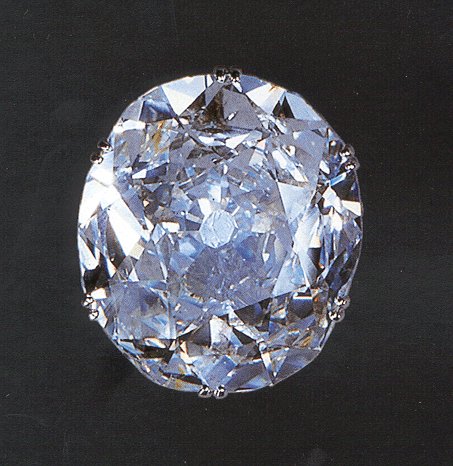
The Koh-i-Noor diamond (pictured at above) or "Mountain of Light" as it was called has a dark history. It was discovered in 1655 and was given to Shah Jahan, the Moghul Emperor and passed through the hands of numerous rulers. After the British military, on behalf of the East India company thwarted a Sikh uprising in 1849 the diamond was taken from Maharaja Dhulip Singh in tribute. The East India company then gave the stone to Queen Victoria on July 3, 1850 and was displayed at the great exhibition of 1851 so many of Collins readers would have seen it. Many viewers at the exhibition were disappointed by the appearance of the stone since Indian custom required the stone to be kept in its natural state. It was only after the Exhibition that the stone was cut in Amsterdam and took on the appearance above, the largest of the pieces and a "jewel of the crown." As a sacred gem the Koh-i-Noor was supposed to bring a curse on anyone who took and misused the stone.

The Orloff diamond is the other source for the moonstone and has a particularly sordid history. It was famously taken from the eye of a Brahman statue by a French soldier who was supposed to have ingratiated himself with local priests and pretended to adopt their religious beliefs before stealing the stone. It was then stolen from the soldier by a ship's Captain who sold the stone to Prince Orloff who gave the stone to Empress Catherine the II and it was placed on the imperial scepter.

The Pitt diamond is another source of material for the moonstone. Collins was a frequent guest of Sir George Russell and heard stories of their family heirloom, the Pitt Diamond. Another potential source was the family diamond of Charles Reade which had been brought home from India by his brother. Collins apparently had one of his mistresses, Martha Rudd, copy out a passage on the Pitt diamond from The Natural History of Precious Stones and Gems. Governor Pitt was deeply afraid of the diamond being stolen that he did not sleep in the same bed twice in a row and would never give notice if he was coming to town so as not to alert anyone to the possible presence of the stone.


The Pitt diamond had its own sordid history. The man who found it cut a gash in his leg to conceal the stone. An English captain lured him onto his ship with promises of finding a buyer and took the stone and threw the man overboard. The sea captain in turn received only 1000 pounds for the stone which he quickly spent then hanged himself. The diamond was taken from Pitt by the French Regent, the Duke of Orleans who sealed the stone and other valuables in the Commune of Paris but when they went to open the seals they were found to be already opened and the diamond stolen. Aspects of this story clearly make their way into the story of the Honorable John Herncastle.

Although most scholars do not seem to suggest that the Hope diamond was used by Collins as one of his models for the Moonstone, it is worth mentioning this famous blue diamond with another complicated history which starts with it being stolen from and Indian statue and ends with the stone being cursed, although some assert that most tales of curses are fabricated to enhance the value of a gem.

The supposed mystical aspects of the diamond are also referenced in passing by Collins. Betteredge calls it a cursed diamond. The attachment to the Indians their religious ceremony and the Indians use of divination to find the stone all tie in with the curses that such famous stones are alleged to carry. Also stones were sometimes believed to be used as a means of divination

Finally, Collins becomes the source for later mystery novels involving the theft of a gem with a violent history, Most notable. Conan Doyle's Sherlock Holmes mystery The Blue Carbuncle.

Tuesday, December 28, 2010

The Moonstone: looking at dates

I thought it might be useful to include some key events that take place in 1848 when The Moonstone is set and 1868 when The Moonstone was written. All information is taken from The Annuls of London and The Timetables of History

1848

London reforms sewer systems since sewage had been directly emptied into the Thames creating health problems such as cholera outbreaks as well as a terrible smell. (For those who followed the Neverwhere blog this is before the Great Stink of 1858 so sewer reform was slow but there had been several cholera outbreaks in the 1840s which started the slow wheels of reform.)

First railway bridge across the Thames carrying the London and South Western line from Richmond to Windsor.

Waterloo station opened in Belgravia. It included a special daily “funeral express to take mourners to Brookwood Cemetery near Woking. (Station pictured at left.)

Chopin gave his first public performance in England in Belgravia which sold out and was considered a great success.

The Communist Manifesto is issued by Marx and Engels.

The Principles of Political Economy by J.S. Mill is published.

Mary Barton by Elizabeth Gaskell is published

The Pre-Raphaelite Brotherhood begins when William Holman Hunt wrote a letter to Dante Gabriel Rossetti to see if they might share studio space.

Queen’s College was established in Harley street for the higher education of women. Male tutors from Kings college were first used so women took courses with chaperones.

As mentioned in an earlier post revolutions are breaking out across Europe.

1868

The last public execution at Newgate prison was held.

The London Underground was expanding rapidly in all directions to accommodate the transportation needs of the city.

The Victoria Embankment along the Thames opened to foot traffic. (Illustration at left.)

The first traffic light with red and green gas lights was installed between Bridge Street and Great George street. The Express reported on December 8th , “ which will serve to foot passengers by way of caution, and at the same time remind drivers of vehicles and equestrians that they ought at this point to slacken their speed.”

Horse racing started at a leisure park in Hornsey.

Charles Darwin publishes The Variation of Animals and Plants Under Domestication. (On the Origin of Species was published in 1859 for additional context.)


Monday, December 27, 2010

Judging a Book by its Cover

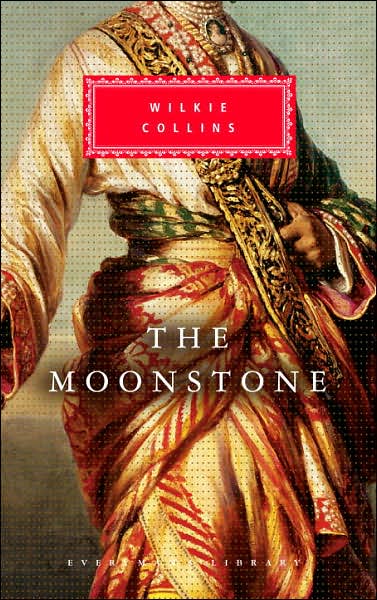
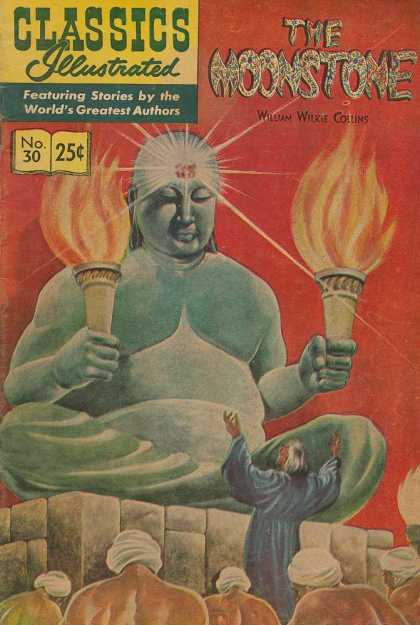
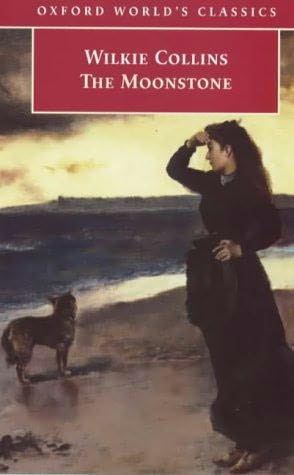
I just wanted to add a second quick post today. The longevity and success of The Moonstone means that it has been issued and reissued and I find the cover art of these books fascinating as they are wildly different. Does the cover show the shivering sands, the diamond, India or the god from whom the stone was taken? Each cover choice seems to highlight a different aspect of what is important to the mystery of the moonstone. Some of the covers are shown below. They tend to fall into four categories: focus on a woman or women (either in fancy dress or at the shivering sands), an exterior of a home or street(generally Gothic looking), the diamond, the Indians or an exoticized image of the god. In the case of older covers these foreign representations seem offensive and on one the quote from Dorothy L. Sayers is larger than Collins name.





Thursday, December 16, 2010

Colonialism and Revolution in The Moonstone


One of the interesting things in thinking about The Moontstone and watching the development of the script as Rob has gone through drafts is how we think about the characters of the Indians as they appear in Victorian England and the history of the moonstone.

What surprised me about The Moonstone when I first read it is that Collins seems to show sympathy for the Indians about original theft of the stone from the statue of the moon god. It may be of interest to know that while Collins does not name the god the description fits with that of Chandra also sometimes known or combined with the god Soma. He pulls the moon across the sky in his chariot and is sometimes depicted riding on an Antelope. He is also a fertility god and associated with vegetation.

While Collins seems to rely on the exoticized east to use the three Indian travelers to create a sense of mystery and fear surrounding their presence in relation to the moonstone.


The status of the stone is already fraught. It has been stolen from the statue city of Somnauth and by a string of thefts and murders has ended up in a cache of stolen gems of Tipu Sahib. The story we are given about how Colonel Hearncastle killed (dishonorably) to possess the stone depicts the ugliness of colonialism and the looting that occurred throughout the British control of India. The stone inherited by Rachel Verinder is stolen goods and taken through violence.

A sense of sympathy is created for the three Indians, whom, we are told by the traveler Murthwaite, have forsaken home and caste to retrieve the stone. Collins also doesn't discount or minimize the mysticism of the Indians or any potential mystical associations with the stone. The Indians practicing scrying, looking into the future in a pool of ink is taken seriously by all but Betteredge. The fears many characters voice over the curse associated with the stone are again taken seriously so the Indians are not belittled as superstitious in comparison to the English.

At the same time it is difficult not to grapple with the fact that to a modern audience any depiction of three Indians in England at this time can seem racially charged, something I think Rob's adaptation goes to great pains to minimize. Ultimately the story is not about the fears of the other, the foreign. The fears and mystery lie in the actions and motivations of the family. One feels the stone might be best with the Indians as a form of restitution.

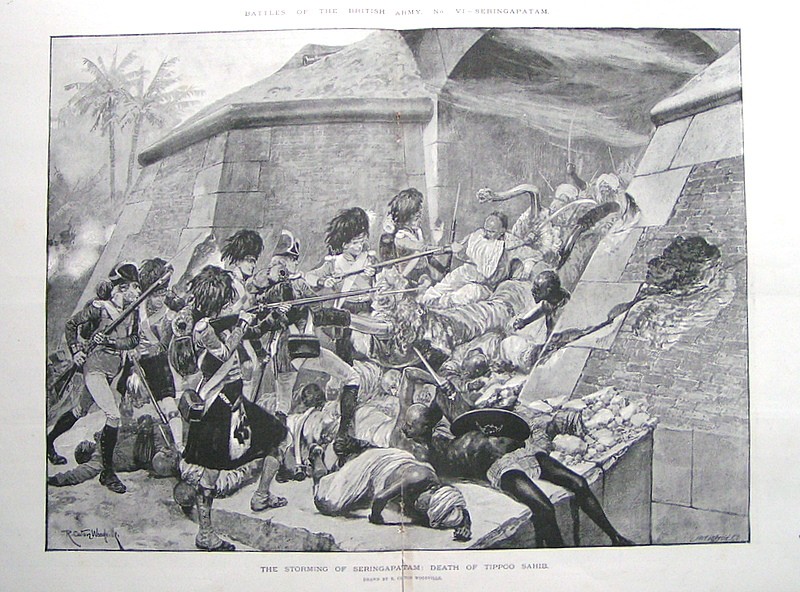
However, I don't want to minimize what Collin's audience would have known about British History in India. "The Storming of Serringpatam" in 1799 in which the stone is taken was a major British victory that ushered in the time of British rule in Southern India (and extended the reaches of the East India Company) in ways that were brutal to the local population. The novel is set in 1848 which is a year of revolutions in Europe (which colors and adds danger to Franklin Blake's European travels). It is also the year of Chartist demonstrations in London where many in the working classes rallied for reforms. Readers would have been aware of the cultural shifts and unrest in both England and abroad. Property, ownership, class and entitlement were not as solidly entrenched as they might have seemed.

Collins reading audience would have known of the earlier battle but also of the recent 1857 Sepoy Rebellion in which Indian troops near Delhi rebelled brought about the dissolution of the East India company in striking contrast to the time at which the gem was taken. Many of Collins' contemporaries referred to horrors inflicted on the English during this time period to portray Indians in a brutal and negative light which Collins seems to avoid but at the same time his readers would have read newspaper accounts about the violence of the Indian uprising and might have been prepared to view the three Indians as figures of fear.

Murthwaite is an interesting comparison to this. His presence in the story is because he is a noted traveler and valued for the conversation he will bring to the various dinner parties he attends when he is not traveling the world. He also acts as an interpreter for the actions and the language of the Indians for the other characters in the story. One source for the character of Murthwaite is John William Shaw Wyllie an Anglo-Indian traveller whom Collins would have met at his club. He also likely referred to the books Talboys Wheeler's The History of India and the Life of Sir David Baird by Theodore Hook.

Tuesday, December 7, 2010

Detective Fever

"Do you feel an uncomfortable heat at the pit of your stomach...and a nasty thumping at the top of your head?...I call it the detective-fever."

- Gabriel Betteridge, The Moonstone


The Moonstone is certainly one of the first detective novels. As such, it both sets many of the standards that will be followed in the genre but at the same time it is a bit more fluid than the standard detective novel.


In The Moonstone many characters play detective in addition to Sergeant Cuff of the Detective Police.


Gabriel Betteridge, Lady’ Julia’s house steward, describes detective fever. He can’t resist asking the servants his own questions.


Mr. Bruff, the family lawyer turns detective both to discover who looked at Lady Verinder’s will, and setting a watch on the bank.


Ezra Jennings pieces together Doctor Candy’s fevered ravings and makes a sensible narrative of them.


Franklin Blake turns amateur detective assembling the evidence of all the other characters to piece together the story.


Sergeant Cuff however represents many of the traits that would become standard to the professional detective. The unassuming appearance, the eccentric behavior, the use of misdirection to elicit answers, would all become part of the trope of the detective.


In this stage adaptation of The Moonstone, we lose the local police Superintendent Seagrave of Frizinghall, who acts as the bumbling, pompous foil to the deductions of Sergeant Cuff, who comes from London. Cuff is a member of the detective-police, a newly established in London where a detective, who specialized in solving crimes would be in charge of cases as opposed to the usual police officers.


Betteridge describes Cuff, "He was dressed all in decent black, with a white cravat round his neck. His face was as sharp as a hatchet, and the skin of it was as yellow and dry and withered as an autumn leaf. His eyes, of a steely light grey, had a very disconcerting trick, when they encountered your eyes, of looking as if they expected something more from you than you were aware of yourself. His walk was soft; his voice was melancholy; his long lanky fingers were hooked like claws. He might have been a parson, or an undertaker--or anything else you like, except what he really was."


In fact, Sergeant Cuff is likely based on a real London police detective, Inspector Jonathan Whicher. The Suspicions of Mr. Whicher traces Whicher's rise, fall and and investigation of the shocking murder of a three-year-old child, Saville Kent. Whicher is pictured at left. Whicher came to suspect a half-sister, Constance Kent and was ridiculed in Punch and his career ruined. Later, Constance Kent confessed but it was too late to resuscitate his career or the shambles of his life.


The new role of the clever detective and the emerging science of deduction was of interest to Collins and his friend Charles Dickens, who wrote several short pieces in his weekly paper Household Words, "The Detective Police," "On Duty with Inspector Field" and and "Three Detective Anecdotes" in which he met, profiled and praised the new order of detectives.


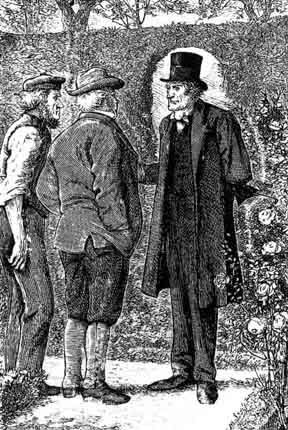
Collins also establishes the Detective with an eccentricity. Cuff loves roses and wants to cultivate them when he retires. He is described whistling "The Last Rose of Summer" an Irish Air by Thomas Moore, that was further popularized as Mendelssohn used it as the source for a fantasia. The lyrics are below.


'Tis the last rose of summer, left blooming all alone
All her lovely companions are faded and gone.
No flower of he kindred, no rose bud is nigh
To reflect back her blushes and give sigh for sigh.

I'll not leave thee, thou lone one! to pine on the stem
Since the lovely are sleeping, go sleep thou with them
Thus kindly I scatter thy leaves o'er the bed
Where thy mates of the garden lie scentless and dead.

So soon may I follow, when friendships decay
And from love's shining circle the gems drop away
When true hearts lie wither'd and fond ones are flown
Oh! who would inhabit this bleak world alone!


The lyrics seems to have additional significance given the role the roses picked for Franklin Blake's button hole play for both Rosanna Spearman mental state and what Rachel Verinder will go through after the theft of the diamond. The decay in the song is not unlike the decay inherited with the moonstone that seems to be destroying and scattering the family unit.


It is also interesting to note that the reader, or, in our case, the audience is asked to participate in this detective-fever. We are given the various accounts related to the missing moonstone and asked to piece them together. In doing so, we are asked to peer into the lives and motivations of the characters and lift the veil of Victorian domestic life.


Wednesday, November 17, 2010

Opium Eating and The Moonstone


The use of opium is featured in several of novels by Wilkie Collins including The Moonstone. Collins was also a user of opium both in laudanum and injections. It is important however to understand that opium was widely used in England at this time as a medicinal remedy. Although Doctors and chemists widely disagreed about both its uses and it the physiological response to the drug it was accepted for use in the home and was not considered a source of shame or moral failing or addiction as an illness in the same way as modern drug use.

Opium is used in a variety of forms all of which are derived from the sticky white juice taken from the opium poppy. It can be prepared in a variety of forms. During the time period it was smoked in pipes, and injected as morphine but most often it was prepared in a brownish/red liquid tincture in alcohol known as laudanum.

Laudanum was widely available and inexpensive in chemist shops in even the smallest English villages. It was commonly given to sooth fussy children and infants. It was sold under a wide variety of names including: Batley's Sedative Solution, Dalby's Carminative, Godfrey's Cordial, McMunn's Elixir, and Mother Bailey's Quieting Syrup for which an advertisement is pictured at left. It was given as a tonic or cure a wide range of illnesses including colds, cholera, hay fever, insomnia, tuberculosis, nervousness, headaches, gout and rheumatism.

In Opium and the Romantic Imagination, Alethea Hayter says that,"Laudanum was cheaper than beer or gin, cheap enough for even the lowest-paid worker." Further in the same work, a chemist in a small Lancashire parish is cited as selling 200 pound of opium per year and a chemist in Thorpe is described as telling Coleride he sold two to three pounds of opium and a gallon of laudanum every market day.

Wilkie Collins saw his father taking "Bately's Drops" to ease the pain of heart disease before his death. When Collins began to suffer symptoms of rheumatism and gout as well as eye pain he began taking laudanum to ease the pain. He would be a lifelong user of laudanum. As his tolerance for the opiate increased so did his dosages. Late in life Collins was taking doses that would have killed a normal person. At a dinner party, he apparently asked the surgeon Sir William Fergusson to verify his claim and Fergusson told the dinner party that the amount of laudanum Collins took nightly was sufficient to kill every man at the dinner table. Collins also received occasional injections of morphine for pain.

Collins seems to have both resented and romanticized his need for laudanum. He claimed he took laudanum "To stimulate the brain and steady the nerves," but he advised his friend Hall Caine against taking it himself. He felt he needed it to bear the pain he suffered but he was also aware of the associations laudanum had with numerous writers. Thomas De Quincey's Confessions of an English Opium-Eater was published in 1821. The use of opium by authors such as Samuel Taylor Coleridge and Charles Baudelaire was also well-known.

Walter Scott claimed to have written part of The Bride of Lammermoor (a novel particularly admired by Collins) while he was under the influence so that when he read it he did not recognize the story as his own. Collins may have remembered this story when he told a similar story about writing The Moonstone. Collins claimed that his pain was so great that he had to dictate the story and that he went through several secretaries before he found one who would ignore his cries of pain. It is clear from the manuscript that some of the pages are written in a different hand. Collins also claimed that he was "pleased and astonished" by the end of The Moonstone but did not recognize it as his own work.

"If I had only myself to think of, I should prefer the sharp pain to the frightful dreams." - Ezra Jennings, The Moonstone

The character of the Doctor Candy's assistant, Ezra Jennings, in The Moonstone is also an opium user many critics have seen him as the voice of Collins speaking when he describes the effects of the opium that keeps him from pain but gives him terrible nightmares. Collins did not describe nightmares as part of the effects of his laudanum use but he did describe waking hallucinations including the feeling that someone was standing behind him, ghosts on the staircase who wanted to push him down and a green woman with tusks who said goodnight by biting his shoulder.

Collins personal experience with laudanum is also represented in his descriptions of the experience of being under its influence which is key in both The Moonstone and his other novels including No Name and Armadale.

Sources: Opium and the Romantic Imagination, Alethea Hayter and Wilkie Collins, An Illustrated Guide, Andrew Gasson

Wednesday, November 10, 2010

The Moonstone and Genre


I confess I have been delaying my first post for The Moonstone. Like a detective novel, there are so many irresistible avenues in which one can pursue when researching Wilkie Collins and the novel. I will try to set us down a number of those paths in the next few weeks without spoiling the mystery.

T.S. Eliot called The Moonstone, “the first and greatest of English detective novels,” but he did so in the context of an essay which praises Collins’ skill with atmosphere, but says that his novels will not have the permanence of Dickens.

G.K. Chesterton called it, “probably the best detective tale in the world.”

Dorothy L. Sayers in a 1944 introduction to The Moonstone said that Collins is “genuinely feminist in his treatment of women.”

It is useful to consider the question of genre.

While critics have categorized The Moonstone the first detective novel, and it certainly is a detective novel. (First detective novel is somewhat contested as a The Notting Hill Mystery by Charles Felix was serialized in 1862 but it did not have the success or longevity of The Moonstone) Collins subtitled The Moonstone "a romance" which has different connotations than our modern notions of romance novels. It is also part of a group of fiction popular in the 1860s known as sensation fiction. The unlike the Gothic novel, with which the sensation novel shares many features, in the Sensation novel the ordinary middle or upper middle class home becomes the scene of a terrible mystery or secret and the fear and pleasure derived in reading the story comes from revelation of some previously undisclosed familial secret. The underpinnings of the family home are made unstable by disclosure of secrets, possibly dark secrets, lying beneath the veneer of public respectability. Generally, the whole notion of genres was more fluid in the Victorian era than in the present.

For the purposes of the stage, this is particularly useful in that layers of knowledge that are revealed slowly overtime are enjoyable for an actor to play and for an audience to watch. It also fits well with Rob’s approach to the adaptation and Paul’s approach to the direction, which is to avoid the potential for vaudeville in favor of focusing real relationships.

It is also worth noting that Collins wrote a version of The Moonstone for the stage which was performed in 4 acts at the Royal Olympic Theatre in 1877. Collins simplified the plot, cut major characters and restricted the action to 24 hours. It was not well received and though it ran for three months the principal actors left the production before the run had finished.

In The Moonstone, Collins both pioneers and, in some cases, subverts the standard devices readers have come to know as the mainstays of detective fiction. An item is stolen from a locked house, there are a limited number of guests and servants who are the suspects, and an eccentric detective (who appears distracted) elicits key information from unsuspecting members of the household. The detective reveals a solution to the mystery based on analysis of the facts. The detective also at one point predicts the name of the guilty party by writing it on a piece of paper and sealing it in an envelope.

For the audience, I think it will be delightful to see these devices revealed on stage. At the same time it is important to realize that for all his popularity with reading public the categories applied to Collins have diminished his status compared to fellow author and friend Charles Dickens, who grappled with similar issues of class and the problems with the laws in England at that time particularly as they pertained to property, women and inheritance.

The novel was published starting January 4, 1868, in 32 weekly installments in All The Year Round, the weekly journal founded by Charles Dickens and simultaneously in the United States in Harper's Weekly. Later in was published in book form in three relatively inexpensive volumes. The structure of the weeklies meant that revelations varied from week to week to keep the readers waiting to see what the next installment would bring which fit well with the emerging literary form that focused on a detective.

The structure of The Moonstone follows the narratives of multiple different characters each giving their information in turn in the hope that the layers of evidence will emerge that will reveal what happened to ill-fated moonstone. This presents unique difficulties and opportunities for the stage and I think Rob has kept the strength and individuality of Collins' competing narrators.

In the days to come I will give more information on the context and the characters but will try to avoid spoilers.

Sources: Wilkie Collins An Illustrated Guide, Andrew Gasson; Wilkie Collins: Women Property and Propriety, Philip O'Neill; Introduction Oxford World's Classics Edition of The Moonstone and Introduction Penguin Classics Edition of The Moonstone